PARKS Atlas
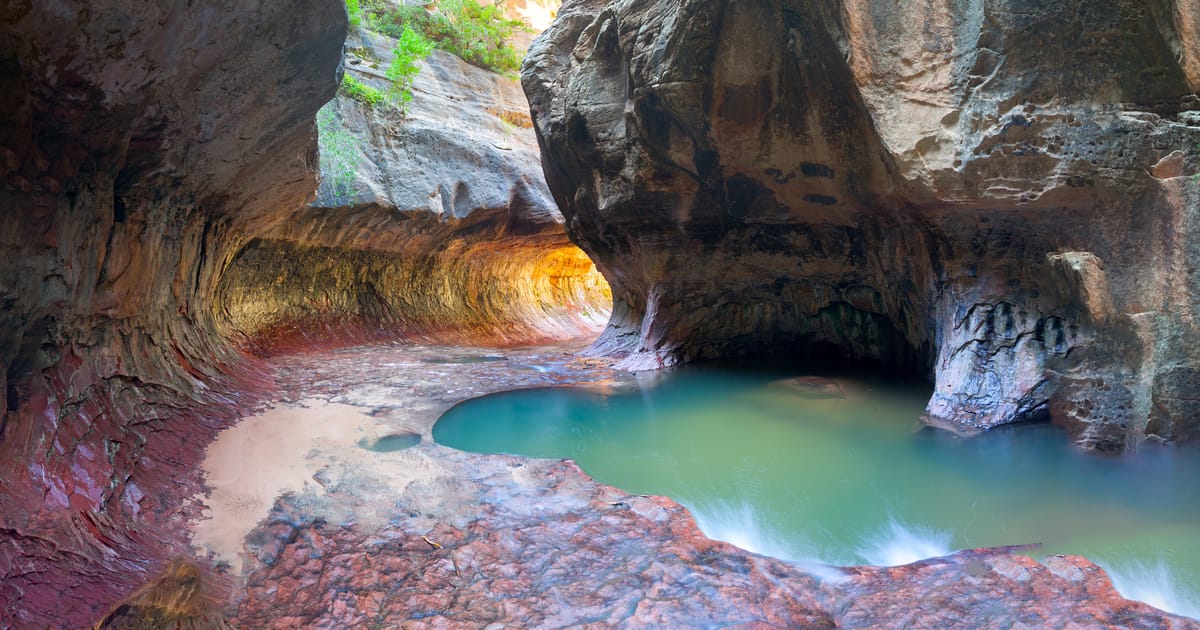
A stunning slot canyon interior known as 'The Subway' in Zion National Park, featuring smooth water-carved sandstone walls glowing with warm amber and rust tones, framing a serene turquoise pool below. The ethereal lighting filters through the…

Utah · National Park

Zion

Utah's headline canyon — 2,000 feet of Navajo sandstone and a river you can walk straight through.

The Subway · Zion National Park

Overview

About Zion

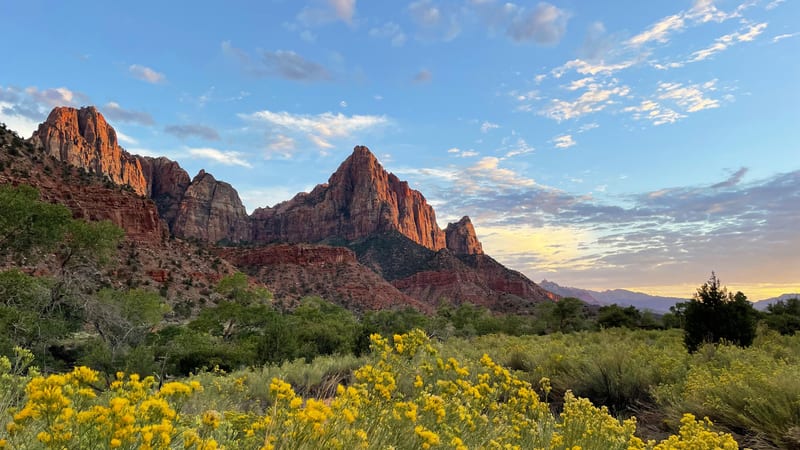
Zion National Park is southwestern Utah's headline canyon — a 15-mile cleft of Navajo sandstone where the Virgin River cuts 2,000 feet below the rim and the cliffs glow rust, cream, and lavender across the day. The main canyon is small, walkable in a single morning, and stays with you for the same reason: every trail puts the wall right above your head.

Established
1919
Size
147,242 acres
Annual visitors
~4.6 million
Elevation range
3,666 – 8,726 ft
Entry fee
$35 / vehicle (7 days)
Designation
National Park

Headline Hikes

Top trails in Zion

  1. Aerial view of the Angels Landing switchback trail carved into red sandstone cliffs above Zion Canyon

    Angels Landing

    4.9 (39,598)

    4.8 mi 1,745 ft gain 3–5 hr

    Strenuous Out & back Permit required

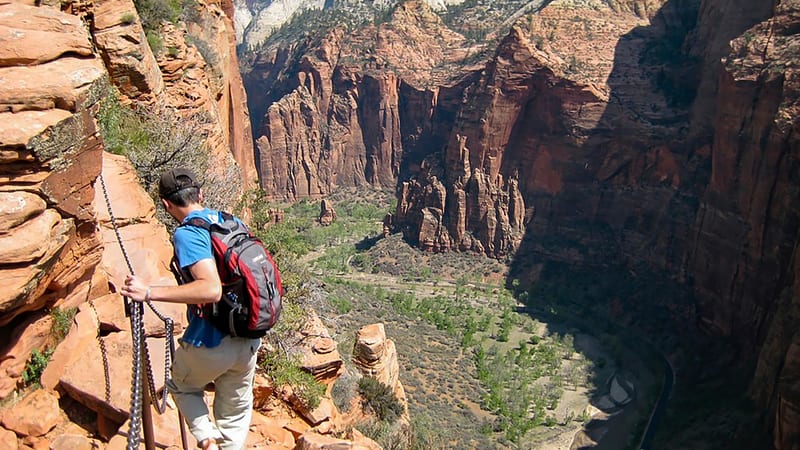
    The chain-clutch ridge walk to a 1,488-ft fin above Zion Canyon. Permit required since 2022 — apply via the seasonal or day-before lottery on Recreation.gov. Budget extra time for the technical sections and avoid when wet or icy.
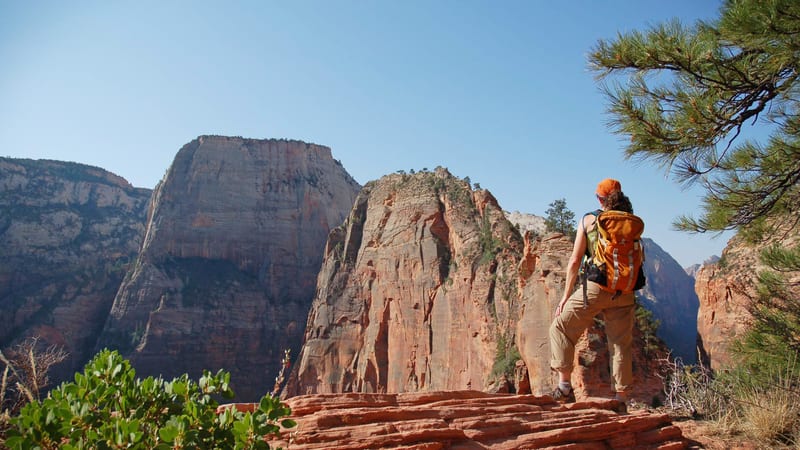
  2. A hiker looking out over a sweeping Zion Canyon vista from a layered sandstone overlook

    Scout Lookout via West Rim Trail

    4.9 (19,848)

    3.8 mi 1,141 ft gain 2.5–3 hr

    Hard Out & back

    Same trailhead and switchbacks as Angels Landing but stops at Scout Lookout — no chains, no permit, and the same canyon overlook the chain section leads to. The smart play if the Angels Landing lottery didn't go your way.

  3. A lone hiker wading the Virgin River between the towering sandstone walls of The Narrows in Zion

    The Narrows (Bottom Up to Big Springs)

    4.9 (6,144)

    9.3 mi 872 ft gain 5–8 hr

    Hard Out & back

    Wade straight up the Virgin River where the canyon pinches to 20 feet wide. The bottom-up day hike from Temple of Sinawava needs no permit — turn around at Big Springs. Rent neoprene socks and a walking stick in Springdale.

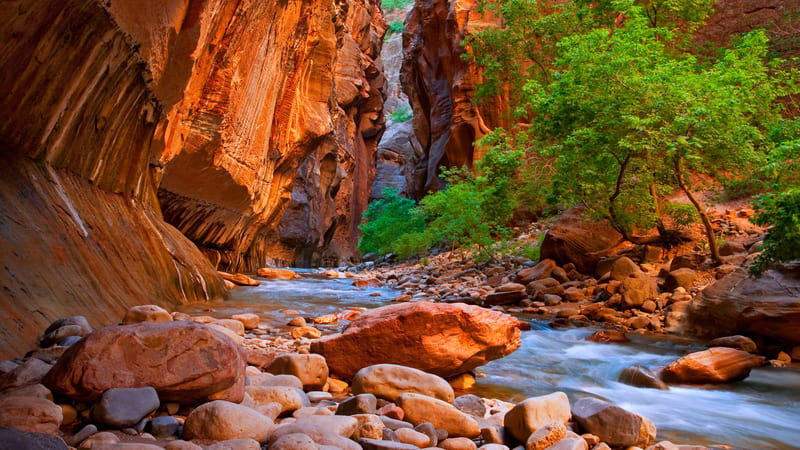
  4. The Virgin River flowing past smooth boulders deep within the red sandstone walls of The Narrows in Zion

    The Narrows (Top Down)

    4.8 (1,503)

    16.8 mi 2,076 ft gain 8–10 hr

    Strenuous Point to point Permit required

    The full through-hike from Chamberlain's Ranch. Permit required — caps at 80 hikers per day. Arrange a shuttle from Springdale. Can be done as an overnight with reserved campsites. The deepest water and tallest walls are in the final 4.5 miles.

  5. A paved riverside trail winding along the Zion Canyon floor beneath towering red sandstone cliffs

    Floating Rock via Narrows Riverside Walk

    4.9 (15,880)

    6.4 mi 1,581 ft gain 3.5–4 hr

    Moderate Out & back

    A taste of the Narrows without the full commitment. Starts on the paved Riverside Walk, then continues into the river to Floating Rock. The water gets knee- to waist-deep — proper shoes are non-negotiable.

  6. A sweeping aerial view of Zion Canyon with red sandstone cliffs flanking the Virgin River valley

    Observation Point via East Mesa Trail

    4.8 (9,485)

    7.0 mi 705 ft gain 2.5–3 hr

    Moderate Out & back

    The big view down onto Angels Landing — taller, quieter, and now best approached from East Mesa Trailhead (4WD required) while the original Weeping Rock route remains closed. Sunrise is the move.

Trail descriptions are field-tested summaries; verify current conditions and closures with NPS before hiking.

See all trails

Permits & Reservations

Permits for Zion

Recreation.gov runs every permit lottery and reservation listed here. Apply in their window — there is no in-person walk-up alternative for the chain section of Angels Landing, the top-down Narrows, or the Subway.

Permit listings sourced from the Recreation Information Database (RIDB). Recreation.gov is the only authorized issuer — verify dates and fees there before applying.

Where to Stay

Lodging near Zion

The top picks across the gateway — in-park, in-town, and basecamp. Each card carries who it suits, why, and a direct booking link; the full lodging list sits below.

  • In-park lodge

    Zion Lodge

    Inside Zion Canyon (shuttle stop #5)

    Price $$$ Proximity Inside the park

    Season Year-round; books out 9–13 months ahead in spring and fall. Off-season (December–February) is the only realistic walk-up window.

    The only in-park lodging — mid-canyon at shuttle stop #5, across from the Emerald Pools trailhead. Cabins and lodge rooms. Book directly through the concessioner; the lodge is the one place inside the park where a private vehicle can park during shuttle season.

    Top pick for accessibility-priority

    Best for

    • Day hikers Mid-canyon at shuttle stop #5 — you start the day on the trailhead side of the shuttle queue instead of waiting on the in-park visitor-center bus from outside the park. Pays for itself on Angels Landing dawn starts and Narrows top-down days when every shuttle hour matters.
    • Families Lodge cabins sleep families without the Springdale-to-canyon shuttle hop. The Emerald Pools trailhead is across the road — the easiest in-park family hike, with the lodge restaurant a five-minute walk back.
    • Accessibility-priority The only in-park option with ADA-accessible rooms and a shuttle stop at the front door — no driving, no shuttle-from-Springdale transfer, no climb from a parking lot. The lodge concessioner publishes accessibility details directly; book through them and confirm room features before arrival.
    • Only in-park hotel
    • Cabins + lodge rooms
    • Private vehicle access during shuttle season

    Concessioner direct booking — operator Xanterra (per NPS Zion 'Lodging' page).

  • Hotel / inn

    Springdale hotels & inns

    Springdale, UT (south entrance)

    Price $$$–$$$$ Proximity At the entrance

    Season Spring and fall book 3–6 months out. Summer fills 1–2 months ahead. Winter is open with steep discounts.

    The primary gateway, immediately outside the south entrance. The town shuttle ties into the canyon shuttle, so you can leave the car parked all week. Boutique inns, mid-range chains, and a handful of higher-end properties along Zion Park Boulevard.

    Top pick for families

    Best for

    • Day hikers Walking distance to the south entrance and the canyon-shuttle hub. Skip the morning parking-lot queue and start your hike at the trailhead, not on the bus from the visitor center.
    • Families The town shuttle ties into the canyon shuttle, so you park once for the trip — no daily reentry queue at the south gate. Restaurants, groceries, and laundry are all walkable from any Zion Park Boulevard property, which is the difference between a vacation and a logistics exercise with kids.
    • Accessibility-priority Chain hotels along Zion Park Boulevard publish accessibility room counts and the town shuttle is wheelchair-accessible — together with the canyon shuttle, that's a barrier-free path from your room to the Riverside Walk and the lodge.
    • Walk to south entrance
    • Town shuttle to canyon shuttle
    • Largest range of properties

    Placeholder — affiliate entity-resolution link cache pending; see _meta.booking_provider_notes.booking_com.

  • Hotel / inn

    Rockville B&Bs

    Rockville, UT (3 mi west of Springdale)

    Price $$$ Proximity 3 mi from gate

    Season Smaller inventory; book early in shoulder season. Often the fallback when Springdale is sold out.

    Three miles west of Springdale on UT-9. Quieter, slower, and several B&Bs along the Virgin River — a good pick if Springdale is booked, noisy, or priced past your line.

    • Quieter than Springdale
    • 5-minute drive to south entrance
    • River-frontage B&Bs

    Placeholder — affiliate entity-resolution link cache pending.

In-park lodges book direct through the concessioner; gateway-town stays surface through partner search.

See all lodging

Where to Base

Towns near Zion

Most visitors base in one of these towns and ride the shuttle in. Springdale puts you at the south entrance; Hurricane and Kanab trade distance for more rooms and lower rates.

  • Basecamp

    Hurricane area

    15.1 mi from the park
    • Lodging
    • Dining
    • Groceries
    • Gas
    • Urgent Care
    • Atm

    Hurricane area — budget I-15 chain basecamp 17 miles west of Zion. Aggregates lodging across Hurricane plus St. George. Compare lodging tiers, prices, and entrance proximity for Zion.

    Population ~115,378

  • Basecamp

    Kanab

    33.9 mi from the park
    • Lodging
    • Dining
    • Gas

    Kanab — three-park east-entrance basecamp 25 miles southeast of Zion. Compare lodging tiers, prices, and entrance proximity for Zion.

    Population ~4,683

  • Gateway Town

    Springdale

    8.3 mi from the park
    • Lodging
    • Dining
    • Shuttle

    Springdale — in-town walkable basecamp right at Zion's south entrance. Compare lodging tiers, prices, and entrance proximity for Zion.

    Population ~514

See all gateway towns

Camping

Camping in Zion

Three campgrounds sit inside the park. All take reservations through Recreation.gov — book the moment your window opens in spring and fall.

Campground listings sourced from the Recreation Information Database (RIDB). Recreation.gov is the only authorized booking site — confirm fees, dates, and site counts there before reserving.

Getting There

Getting to Zion

Most visitors fly into Las Vegas and drive 2h 45m up I-15. The east entrance is the smart play if you're routing in from Bryce or Page.

Drive approaches

  • Las Vegas, NV 2h 45m

    via I-15 N + UT-9 E

    Most common approach. Add 30 minutes in peak season for the Springdale shuttle queue.

  • Salt Lake City, UT 4h 15m

    via I-15 S + UT-17 + UT-9

    Longer but flat and freeway-fast.

  • Bryce Canyon, UT 1h 45m

    via UT-12 + US-89 + UT-9

    The classic Mighty 5 east-entrance route — clears the Mt. Carmel tunnel.

  • Page, AZ 2h 15m

    via US-89 + UT-9 (east entrance)

    Skips Springdale traffic entirely if you base on the east side.

Entrance stations

  • South Entrance (Springdale)

    The main entrance, fronting the canyon shuttle hub. Expect lines from 8am to 11am in spring and fall; arrive before 7am or after 3pm.

    Best for Zion Canyon, Angels Landing, Narrows bottom-up

  • East Entrance (Mt. Carmel)

    Drives in via the historic Zion–Mt. Carmel Highway and the 1.1-mile tunnel. Oversize vehicles (>11'4" tall or >7'10" wide) need a one-way tunnel escort and a permit.

    Best for Canyon Overlook, scenic drive-throughs, Bryce-to-Zion route

  • Kolob Canyons Entrance

    Separate north-end entrance off I-15 exit 40 — 40 minutes from the main canyon. A different geological face of Zion, almost always uncrowded.

    Best for Day hikes (Taylor Creek, Timber Creek), avoiding shuttle lines

Shuttle system

Required during peak season

Private vehicles cannot drive into Zion Canyon from roughly March through late November. The free park shuttle runs from the visitor center to nine canyon stops; expect a 30–45 minute wait at the southern end during peak season. Off-season (typically December–February), private vehicles are allowed back in.

Season Mar – late Nov (verify current year)

Shuttle dates shift year to year. Confirm the current operating window on the NPS Zion alerts page before your trip — early-March and late-November dates are the most volatile.

Sightseeing

Viewpoints in Zion

From roadside pullouts to the chained summit of Angels Landing — the canyon's best views, sorted by how hard they are to reach and when the light is best.

  • Summit

    Angels Landing

    Permit required

    Narrow fin summit reached by chained switchbacks with sheer drops over Zion Canyon; lottery permit required.

    Best at midday

  • Roadside Pullout

    Big Bend

    Roadside

    Shuttle stop with a sweeping view of the Great White Throne and Angels Landing from the canyon floor.

    Best at sunset

  • Overlook

    Canyon Overlook

    Short walk

    Railing perch over lower Zion Canyon and Pine Creek, a 1-mile round-trip hike east of the Mt. Carmel tunnel.

    Best at sunset

  • Overlook

    Observation Point

    Hike required

    High rim viewpoint looking down on Angels Landing and the canyon, reached via the East Mesa Trail or East Rim.

    Best at midday

When to Go

The best time to visit Zion

Best Time to Visit

Zion

Spring & fall. Summer is hot and crowded; the canyon shuttle runs spring through late fall.

  • April
  • May
  • September
  • October
Spring
70° / 40°F
Summer
98° / 68°F
Fall
78° / 47°F
Winter
52° / 29°F

Plan Your Trip

Tips for visiting Zion

Best times to visit

  • Sweet spot

    April – early May, late September – October

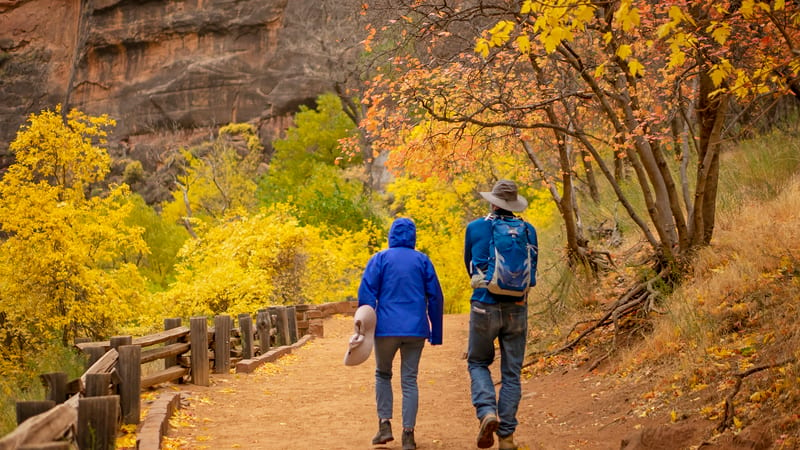
    Cottonwoods leaf out or turn yellow, daytime highs 70–80°F, river temperatures still cool but tolerable for the Narrows.

  • Shoulder

    November – early March

    Quietest. Private vehicles often allowed into the canyon. Snow possible on rim trails; Angels Landing chains can ice.

  • Avoid (if you can)

    Mid-June – August

    Canyon temps push 100°F+, the Narrows closes during flash-flood watches, shuttle lines run an hour at the south entrance.

What to pack

  • Neoprene socks + sturdy water shoes The Narrows is half wade, half ankle-rolling cobble — bare-foot or running-shoe combos will blister inside a mile.
  • Trekking pole or wading stick River current in the Narrows runs ankle- to thigh-deep with hidden boulders; one pole more than doubles your balance.
  • Sun hoody + wide-brim hat Canyon walls reflect heat in summer; UPF layering beats sunscreen for the back-of-neck Angels Landing climb.
  • Electrolyte mix + 3L water capacity Zion is a desert canyon with deceptive shade. Salt loss is the most common reason rangers respond to heat calls.
  • Headlamp (even for day hikes) Sunrise starts on Angels Landing and Narrows beat the heat and the lines — but you'll be on trail before dawn.
  • Dry bag for phones and wallets Any Narrows-bound day will dunk you above the waist at some point. Two 5L roll-tops handle a couple's electronics.

Permits & reservations

  • Angels Landing permit

    Required since April 2022 for the chain section above Scout Lookout. Seasonal lottery runs a quarter ahead; a day-before lottery picks up cancellations. Apply via Recreation.gov.

    Application window Seasonal lottery + day-before lottery

  • Narrows top-down permit

    Only the through-hike from Chamberlain's Ranch needs a permit; the bottom-up day hike from Temple of Sinawava does not. Permit caps the through-hike to 80 hikers per day.

    Application window Calendar lottery 3 months out

  • The Subway permit

    Both top-down (technical canyoneering) and bottom-up (route-finding scramble) require permits. The Subway lottery is the most competitive in the park.

    Application window Monthly lottery 3 months ahead

Recreation.gov is the only authorized lottery + permit issuer. Anyone selling Angels Landing or Narrows permits outside Recreation.gov is a scam — there is no in-person walk-up alternative for either.

What to Pack

Gear for Zion

The short list for a Zion day on the trails — what earns its place in the pack, and where to get it.

  • Packs

    Day Hiking Backpack

    $148–$202

    Whether you're bagging peaks or on a bikepacking adventure, the men's Osprey Talon 22 pack is the ideal solution for toting all the gear you need while keeping you comfortable for the long haul.

    Why it matters Carries water, snacks, and layers for a full day on trail with a comfortable hipbelt.

  • Footwear

    Hiking Boots

    $136–$185

    Take on urban landscapes in the Merrell Moab 3 Lux shoes. These hiking shoes use full-grain leather for a traditional look that doesn't lack support.

    Why it matters Grippy, broken-in-comfortable boots with a wide toe box for mixed park terrain.

  • Footwear

    Trail Runners

    $127–$173

    Keep confidence underfoot. With excellent grip and the same reassuring comfort as the original, the men's Salomon Speedcross 6 trail-running shoes offer a powerful connection to the trails.

    Why it matters Lighter than boots for fast, dry-trail days; many hikers prefer them.

  • Safety

    Trekking Poles

    $101–$138

    Balancing comfort and reliability, the 3-piece-adjustable Black Diamond Trail trekking poles have updated EVA foam grips and plush straps for added security and improved handling on the trail.

    Why it matters Save your knees on descents and steady you across stream crossings like the Narrows.

  • Water

    Hydration Reservoir

    $34–$47

    With high-flow hydration and an on/off lever at the bite valve that makes it easy to prevent leaks, there's a lot to like about like the CamelBak Crux Crux 2-liter reservoir.

    Why it matters Drink hands-free on the move so you actually stay hydrated in the heat.

  • Water

    Insulated Water Bottle

    $38–$52

    Stay refreshed and hydrated wherever you wander with a 32 fl. oz. Hydro Flask Wide-Mouth insulated water bottle equipped with a leakproof Flex Straw cap and 24-hour insulation.

    Why it matters Keeps water cold all day; the most-used item in any park daypack.

Prices and stock change often — confirm the current price with the retailer before buying.

Save on Entry

One pass covers Zion — and every other US national park.

The America the Beautiful annual pass pays for itself in two or three park visits. Free entry, free passenger fees, and no more fumbling for a credit card at the kiosk.

Buy your pass → Learn more about the pass

Ships from US Park Pass. Free shipping in the continental US.