
At a glance
What you’re signing up for
Honest gut-check
Is this trail right for you?
Angels Landing rewards people who genuinely want it — and it’s an honest no for plenty of others. Here’s the straight version, so you can decide before you’re standing at the chains.
Go for it if…
You want the signature Zion hike
This is the view that put Zion on every bucket list — and you earn every foot of it.
Steep, sustained climbing doesn’t scare you
The approach is two-plus hours of relentless uphill before the chains even begin.
Big drops don’t rattle you
The final half-mile is a narrow rock fin with a chain for balance — and a lot of open air on both sides.
You have a permit
Required year-round, won through the Recreation.gov lottery. No permit, no chains.
Maybe skip it if…
Heights genuinely frighten you
This isn’t a “face your fear” trail. The ridge is narrow, the drops fall away on both sides, and a steel chain is the only handhold.
You’re hiking with young kids or a dog
Neither is allowed past Scout Lookout, where the chain section starts.
The rock is wet, icy, or storms are forecast
Navajo sandstone turns slick when wet, and an exposed ridge is the worst place in the park to be caught in a thunderstorm.
You didn’t draw a permit
You can still hike to Scout Lookout for nearly the same view — see Plan B below.
The experience
What it actually feels like
Walked through the way a friend who’s done it would tell you — the climb, the chains, and the summit, with nothing dressed up and nothing left out.
The approach — Walter’s Wiggles to Scout Lookout
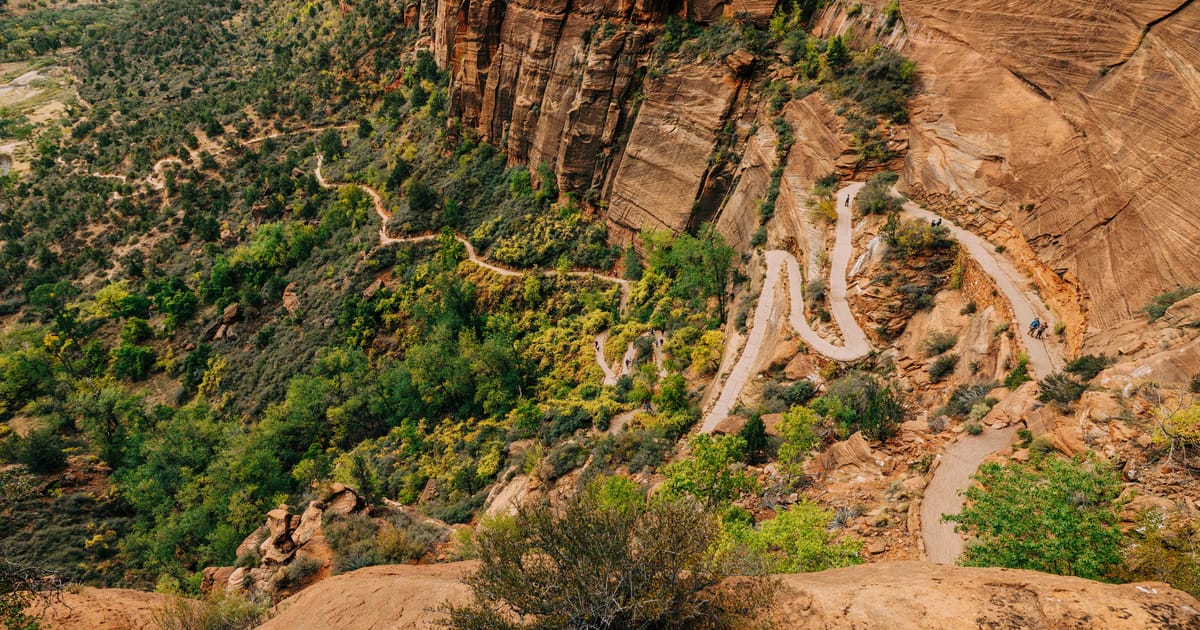
The first two miles do almost all of the elevation. A paved path climbs steadily off the canyon floor, then tightens into Walter’s Wiggles: 21 short switchbacks stacked into the cliff face. It’s a leg-burner — but it’s also completely ordinary hiking. The trail is wide and solid, with the mountain on one side and nothing alarming on the other. If your group is gassed by the top of the Wiggles, that’s worth knowing: the hard part hasn’t started yet.
- Paved and well-graded — steep, but never technical
- Scout Lookout is the permit checkpoint and the start of the chains
The chains — Scout Lookout to the summit
Past Scout Lookout the trail changes completely. The final half-mile follows a narrow rock fin to the summit. In the tightest spots the walkable rock is about three feet wide, with drops of 800 feet or more falling away on both sides. There is no railing. What you hold onto is a chain — heavy steel links bolted into the sandstone — and you move from anchor to anchor, often waiting your turn, because the same chain carries hikers heading up and coming down.
You’re holding a chain, on a fin of rock three feet wide, with the canyon floor a long way down on either side. It’s exactly as real as it sounds — and thousands of ordinary, careful people do it every week.
The summit
The top is a small, flat patch of rock — room for maybe 20 people to spread out. The reward is the canyon floor 1,488 feet straight below, the Virgin River threading through it, and Zion’s walls fanning out in every direction. Most people sit, catch their breath, and take it in for 10 or 15 minutes before starting back.
Going down is its own thing. You descend the chains facing outward, which makes the drops feel more present than they did on the way up. Take it slow, keep three points of contact, and it’s manageable — most of the nerves are in the anticipation, not the doing.
Timing
When to go
Season decides almost everything here — heat, crowds, ice, and how hard the permit is to win. Scan across and pick your window.
- Temps
- 50–80°F
- Crowds
- Building
- Shuttle
- Running
- Permit lottery
- Seasonal lottery (apply ~2 months out) + day-before lottery
Mild temperatures, cottonwoods leafing out, and a lottery that isn’t yet cut-throat.
- Temps
- 95–105°F+
- Crowds
- Peak
- Shuttle
- Running
- Permit lottery
- Most competitive lottery of the year
Brutal heat on bare rock with zero shade — the steel chains get too hot to grip bare-handed by mid-morning. Take the first shuttle or skip it.
- Temps
- 45–85°F
- Crowds
- Easing
- Shuttle
- Running (reduced in late fall)
- Permit lottery
- Seasonal lottery + day-before lottery
Cooler air, golden light, and thinning crowds — arguably the best window of the year.
- Temps
- 30–55°F
- Crowds
- Lightest
- Shuttle
- Limited — private cars often allowed
- Permit lottery
- Easiest lottery to win
Ice on the chains is common and genuinely dangerous; the section closes or becomes a serious hazard after snow.
Trail conditions shift fast — slick rock, ice on the chains, recent rockfall. Check recent reports before you drive out: See AllTrails conditions
Gear
What to bring
Short list, with the reasoning attached — because on this trail the why is what keeps a small oversight from becoming a real problem.
Bring it or turn around
Your permit
Checked by a ranger at Scout Lookout — and yes, it’s enforced. Without it you don’t go past that point, and there is no walk-up option for the chains.
Enter the Recreation.gov lottery →Shoes with real grip
Sticky rubber and a defined tread. Sandals and smooth-soled sneakers slide on polished sandstone — slipping on the chains is the most common preventable mistake on this trail.
At least 2 liters of water per person
There is no water anywhere on the trail. On a hot day you’ll want more — dehydration on the exposed ridge is how a hard hike turns into a dangerous one.
Bring it and you’ll be glad
Light gloves
The chains are sun-baked metal by mid-morning and rough on bare hands. Three-dollar garden gloves do the job.
Salty snacks
The exposed climb pulls more sweat out of you than you expect; salt helps your body hold onto the water you drink.
A warm layer for the start
The canyon floor is cool before sunrise even when the afternoon hits triple digits — and the earliest start is the best start.
Headlamp
Only if you start before dawn to beat the crowds and the heat (see When to go).
Leave it behind
Trekking poles
You need both hands free for the chains, and there’s nowhere good to stow poles at the permit checkpoint. They’re a liability here, not a help.
Heavy camera gear
You won’t want to fumble with a bag on the ridge. A phone in a zipped pocket is the right call.
Backup plans
Always have a Plan B
Angels Landing doesn’t work out for everyone who wants it — the lottery, the heat, the heights, the clock. Find your reason below; each one has a Zion hike worth the drive.
The Narrows (bottom-up)
Up to 9.4 mi · 5–8 hr · Hard
Why this one You hike in the river itself — canyon walls shade you and the water keeps you cool. No exposure, and no permit for the day hike.
A completely different side of Zion: wading the Virgin River between thousand-foot walls. Turn around whenever you like.
Riverside Walk
2.2 mi · 1 hr · Easy
Why this one Paved, shaded and river-cooled — the easy call when it’s hot or the forecast looks unsettled.
Flat and gentle along the Virgin River. It’s also the gateway path to the start of the Narrows.
Save on Entry
One pass covers Zion — and every other US national park.
The America the Beautiful annual pass pays for itself in two or three park visits. Free entry, free passenger fees, and no more fumbling for a credit card at the kiosk.
Ships from US Park Pass. Free shipping in the continental US.